Defense & Security
Human-domain integration for SOF, Civil Affairs, and security cooperation—built for operators who own the problem.
From fragile states to agricultural markets, Kairos gives decision-makers real-time visibility into how people respond to change, risk, and opportunity—so strategy catches up with reality.
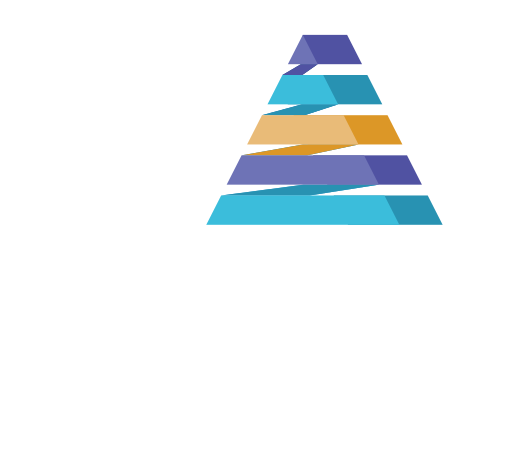
The Kairos Group will measure the PRAPS-2 conflict indicator across the Sahel, using KATS to connect field testimony to pastoral investments and emerging risk signals.
Read the announcementKATS was selected to demonstrate at TE 26-2, alongside companies working at the leading edge of agentic AI, autonomy, and defense innovation.
Read the field noteSTATINFO is our field implementation partner in West Africa, from the Senegal pilot to the PRAPS-2 study, bringing enumerator networks and survey expertise to every KATS deployment.
See the Senegal pilotIt does not tell you what is happening—or what will happen next. By the time monitoring reports arrive, the decision window has already closed. Leaders need signal, not archaeology.
Kairos combines all three to deliver real-time, decision-grade insight into the human domain—the place where strategy actually succeeds or fails.
We work across three domains that share a common truth: outcomes depend on how people perceive, trust, and respond. The methods transfer. The stakes translate.
Human-domain integration for SOF, Civil Affairs, and security cooperation—built for operators who own the problem.
Real-time monitoring of agricultural systems, resilience, and community dynamics across complex programs.
Understanding behavior, risk, and participation in complex value chains—from farm gate to market.
Our offerings work independently and together. Most engagements combine all three—sensing to generate signal, decision support to translate it into action, and system monitoring to close the loop.
Structured field observation at the level where dynamics are decided—households, markets, communities, command posts. We train local enumerators, capture data through offline-capable mobile tools, and aggregate into a continuous read of the environment.
Data without a decision attached is wallpaper. Our analysts convert field signal into concise, calibrated briefs that match the tempo and risk tolerance of the leaders who use them.
Complex systems do not fail all at once—they drift. We establish continuous monitoring regimes that detect drift early and surface the structural dynamics driving change.
Field-based observation meets AI-supported analysis. KATS turns what happens on the ground into structured, real-time signal that decision-makers can act on—without waiting for the next quarterly report.
The acronym KATS stands for The Kairos Agentic Trust and Sensemaking Platform.
KATS is currently deployed under a World Bank-funded CILSS contract (PRAPS-2) across the Sahel, and was selected to demonstrate at USSOCOM Technology Experimentation 26-2.
Enumerators capture observations where connectivity is intermittent; data syncs when a signal is available.
Language and behavioral models surface themes, anomalies, and sentiment shifts across observations.
New observations continuously update confidence in each indicator—so the dashboard reflects current reality.
Configurable dashboards for operators, analysts, and principals—with the depth each role actually needs.
KATS combines four proven elements. Each is simple on its own. Together they turn the human domain into something you can monitor, measure, and act on.
Two structured observations, one narrative, one decision cue. A lightweight protocol designed for field tempo.
A calibrated measure of perceived legitimacy and reliability between actors, tracked over time. Deployed with defense partners as part of human-domain integration.
Quantifies participation, reciprocity, and voice—across locations and demographic segments.
Location-aware views, trend detection, and drill-down access to the underlying narrative data.
Kairos methods travel across sectors because the human domain does. Select a domain to see how our sensing and decision-support work in practice.
For SOF, Civil Affairs, and security-cooperation teams, the hardest questions are rarely about capacity—they are about legitimacy, influence, and trust in the human terrain. We equip operators to read that terrain continuously, not episodically.
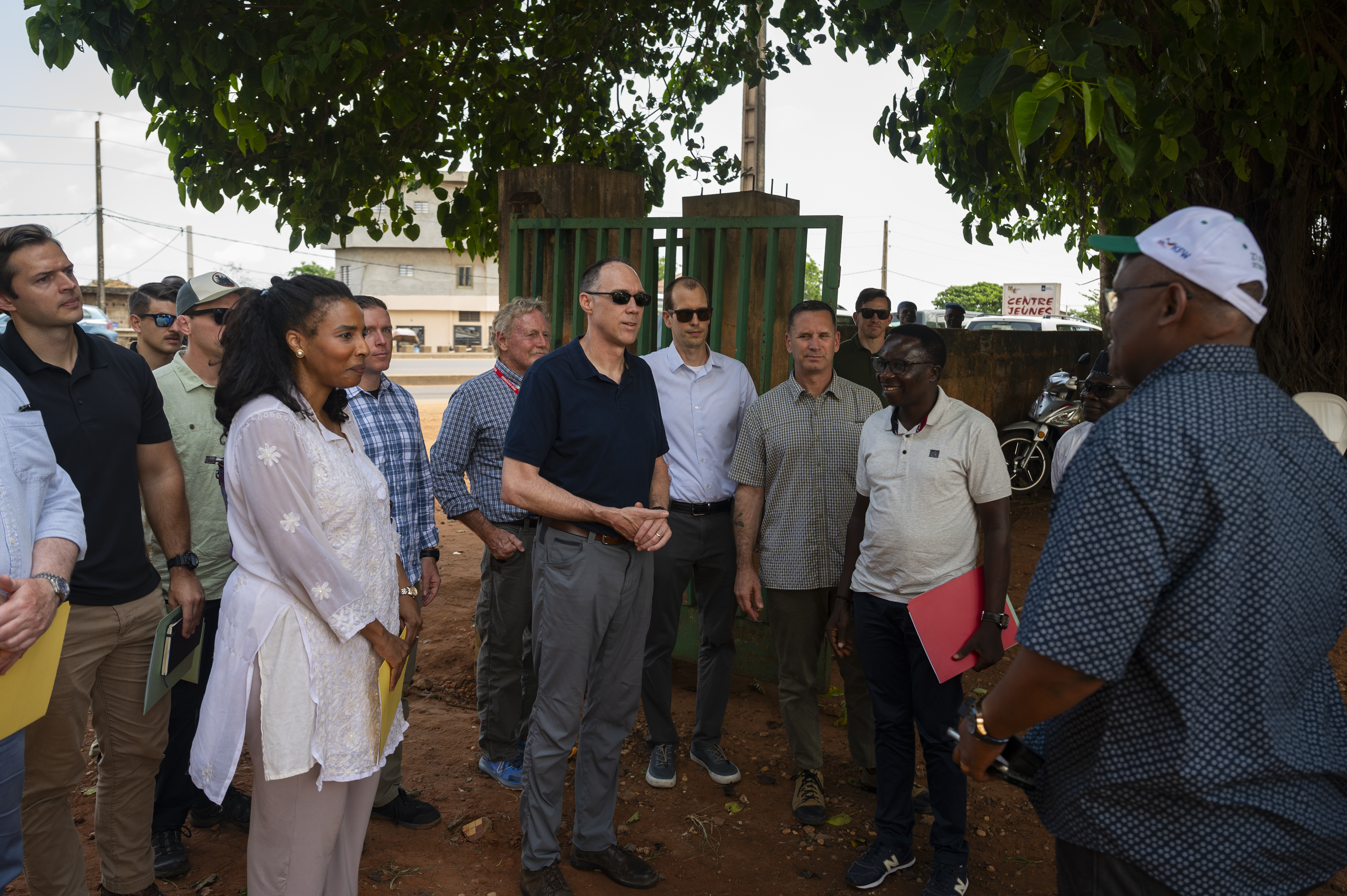
Donor-funded programs often know their activities better than their outcomes, and their outcomes better than the human response driving them. Kairos gives implementers and funders a continuous read on what is actually happening in communities—during and after the program.
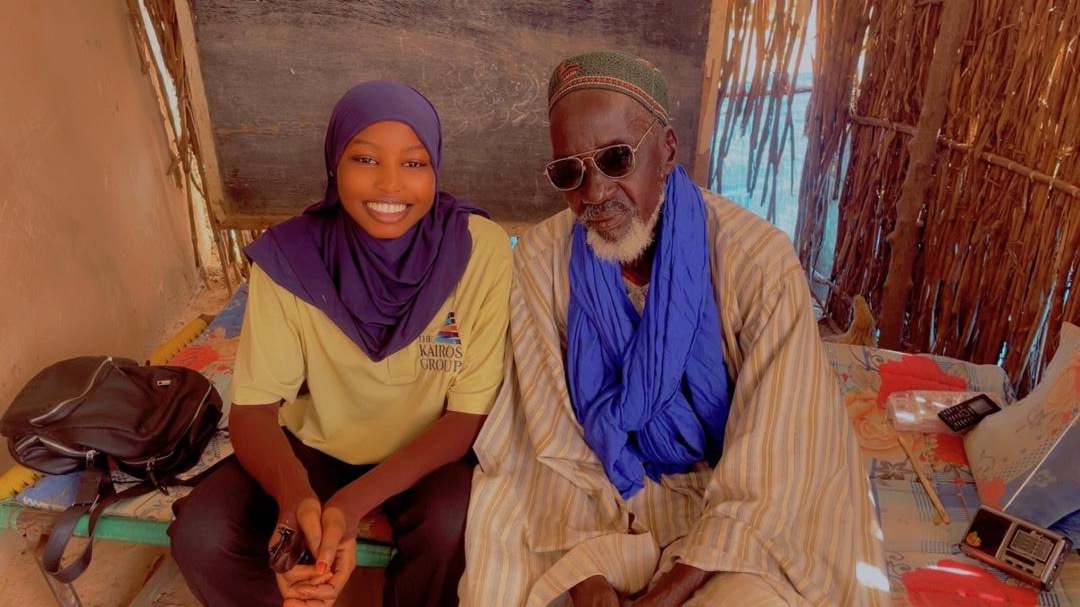
Value chains that stretch across fragile geographies live or die on trust and behavior at the node level. Kairos surfaces the risks that desk-based analytics cannot see—before they become disruptions.
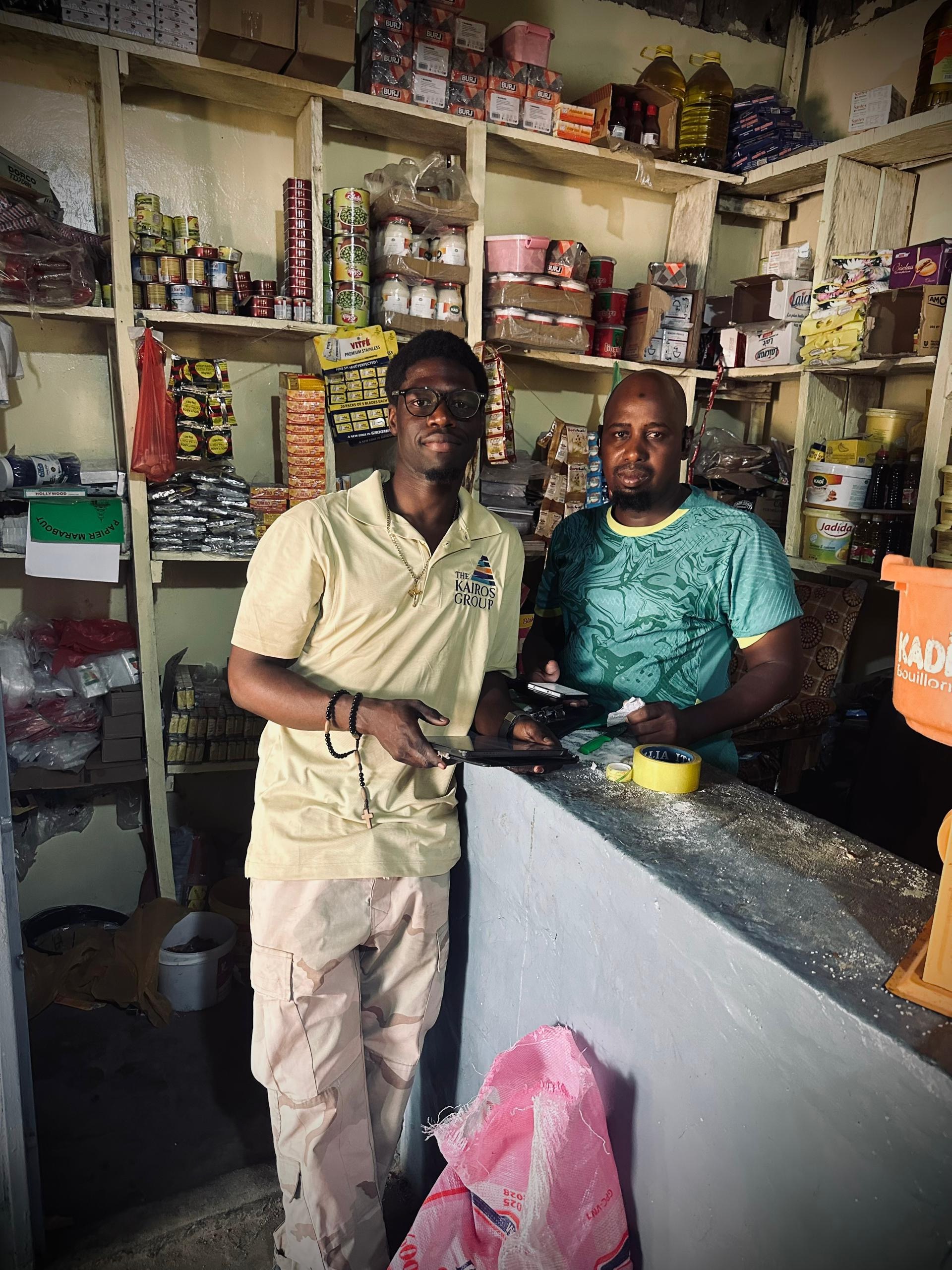
A structured pilot deployment of the KATS platform across two agricultural regions of Senegal, designed to test whether human-domain sensing can anticipate system stress before traditional indicators catch up.
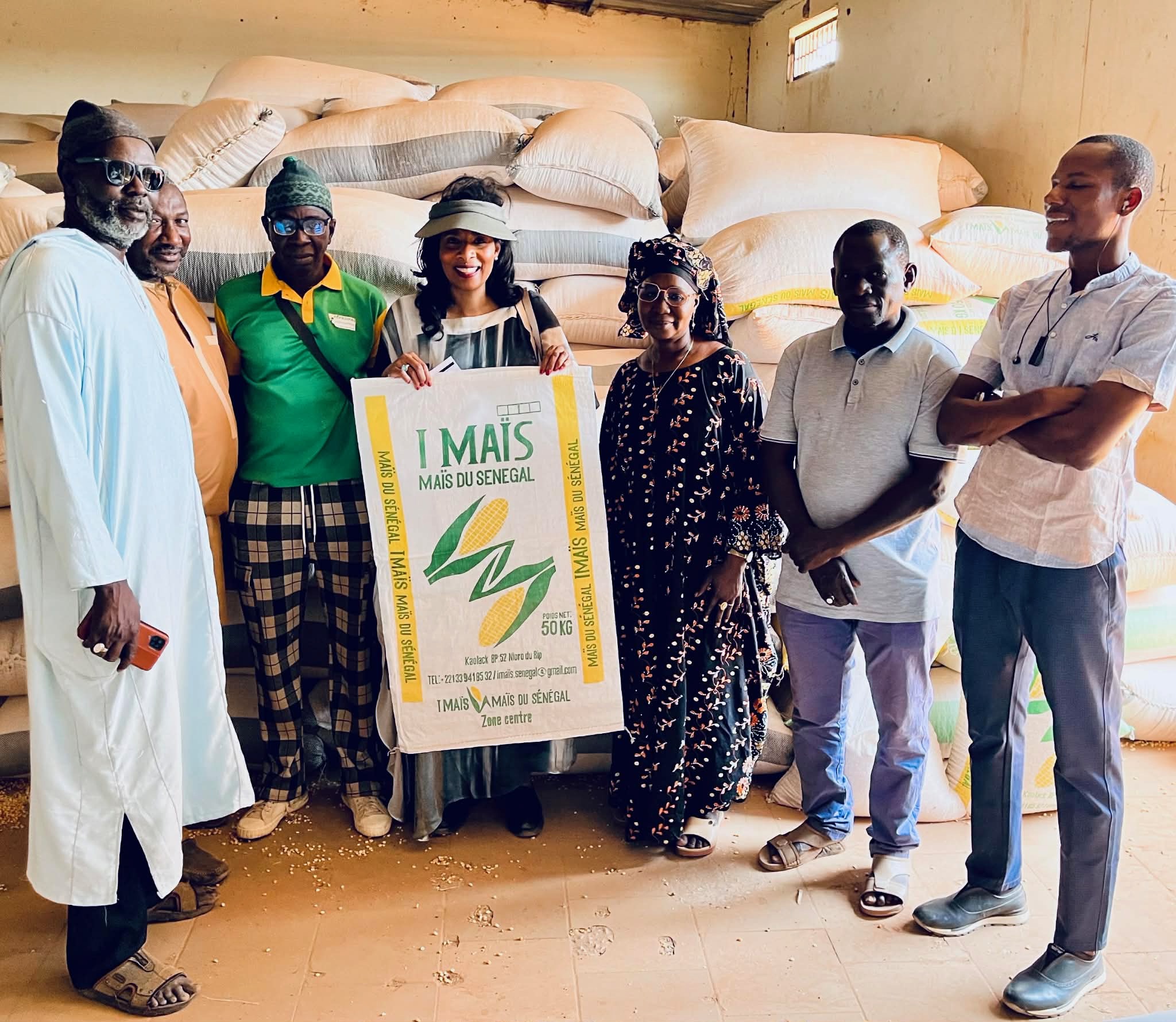
Kairos deployed local enumerators across Kaolack (Saloum) and Kolda (Casamance) to capture farmer interviews, market observations, and continuous readouts of confidence and participation. All data flowed into KATS for real-time analysis.
CEI readings trended downward across the campaign. Farmers reported falling confidence in input delivery and market offtake. Early warning indicators crossed threshold before volumes did— giving programs a window to respond.
Kaolack showed a different pattern: participation held, local coordination strengthened, and farmers adapted planting and selling behavior in ways consistent with long-term engagement. A reference signature for what resilience looks like in the data.
| Dimension | KoldaCasamance | KaolackSaloum |
|---|---|---|
| Participation | −0.8 | +0.9 |
| Inclusion | −0.5 | +0.6 |
| Agency | −0.7 | +0.8 |
| Forward Confidence | −1.2 | +1.1 |
| CEI Score | −0.80~30/100 | +0.85~71/100 |
Illustrative composite values from the pilot window.
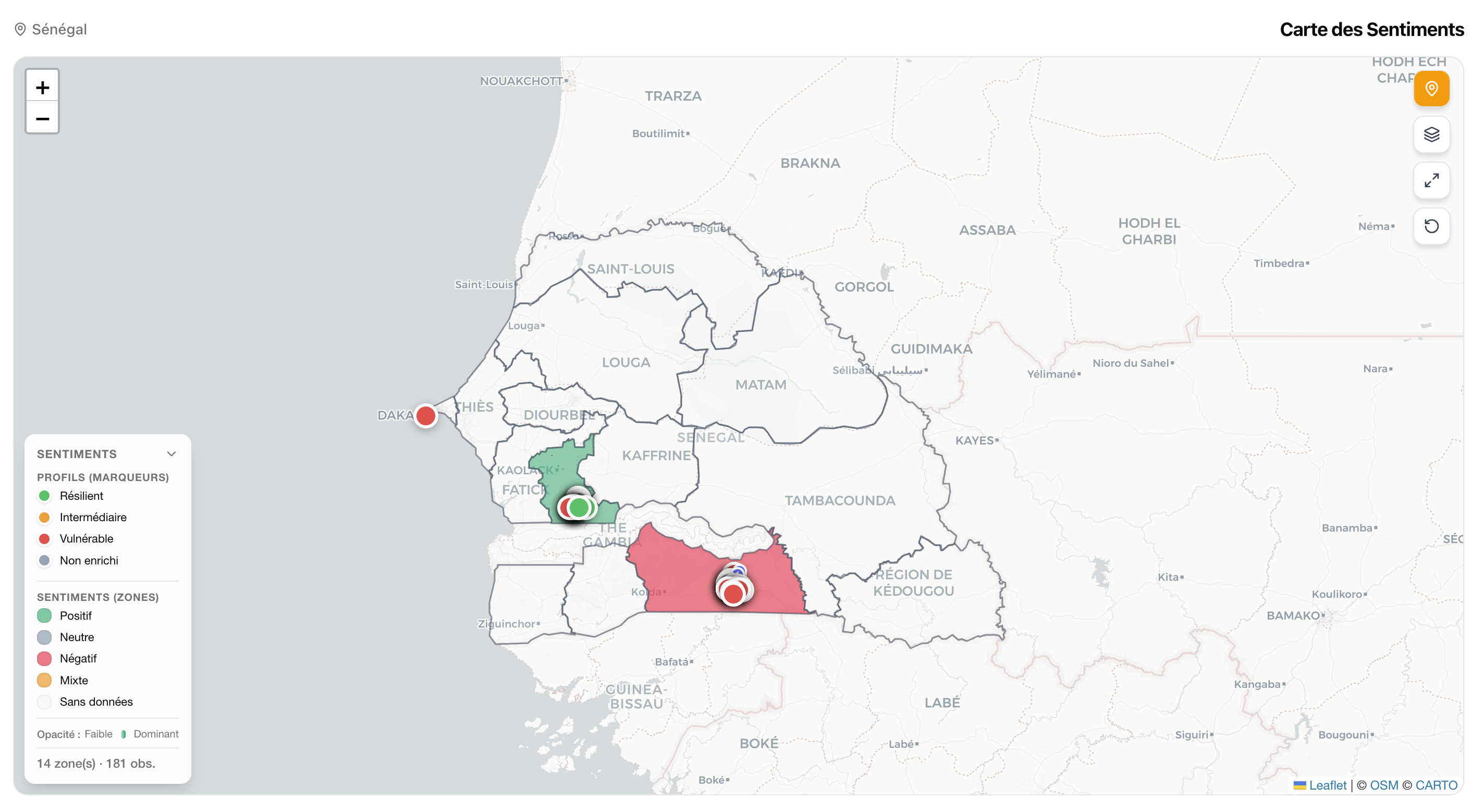
images/senegal-sentiment-map.png
and it will appear here exactly as exported — Kaolack (Résilient / Positif), Kolda (Vulnérable / Négatif), and the built-in KATS legend.
2. Observations — Farmer reports delayed seed delivery; cooperative meeting attendance down from prior week.
1. Narrative — Uncertainty about extension support is eroding willingness to plant on schedule.
1. Decision cue — Flag for program manager: confirm input pipeline within 72 hours.
Dispatches from the work: what we are observing, what we are building, and what it means for leaders operating in complex environments.
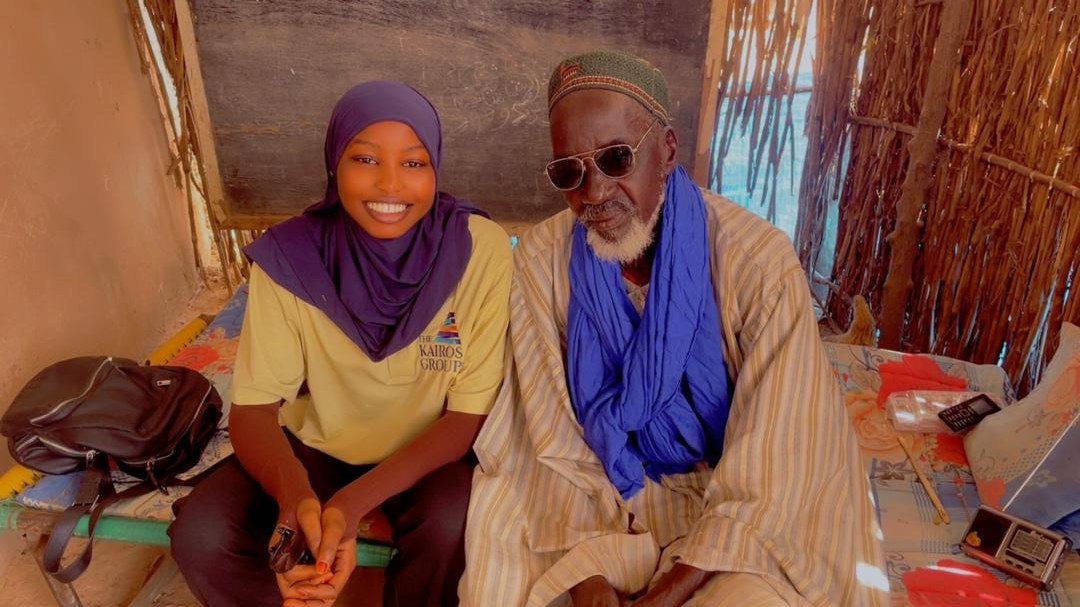
The Kairos Group is pleased to announce the signing of a contract with CILSS — the Permanent Interstate Committee for Drought Control in the Sahel — under the World Bank-funded Regional Sahel Pastoralism Support Project – Phase 2 (PRAPS-2). Working with our partner STATINFO, this assignment will support the strengthening of PRAPS-2’s conflict indicator by examining how beneficiaries and other local actors perceive the evolution of conflicts related to the use of and access to pastoral resources.
Pastoralism remains central to resilience across the Sahel. Yet access to water, pasture, transhumance corridors, livestock markets, and veterinary services continues to be a source of tension in many areas. These tensions may be linked to crop damage, blocked corridors, insecurity, land pressure, climate variability, weak local governance, or disputes over who has access to shared resources.
The purpose of this study is to help CILSS, the World Bank, and national PRAPS teams better understand whether PRAPS investments are contributing to conflict reduction — and, just as importantly, how and why those changes are occurring.
This study will combine quantitative and qualitative data.
The quantitative component will support the formal measurement of PRAPS-2’s conflict indicator. In each country covered, the study will survey randomly selected beneficiaries to estimate the percentage who believe PRAPS investments contribute to reducing conflicts linked to pastoral resources.
The qualitative component will use the KATS platform to go deeper. Through structured field interviews, KATS will help capture the lived experience behind the indicator: how people use PRAPS investments, whether rules are known and applied, how disputes are managed, who benefits, who may feel excluded, and what early signs of tension communities are already observing.
This mixed approach is important because an indicator can tell us what people think, but qualitative evidence helps explain why they think it.
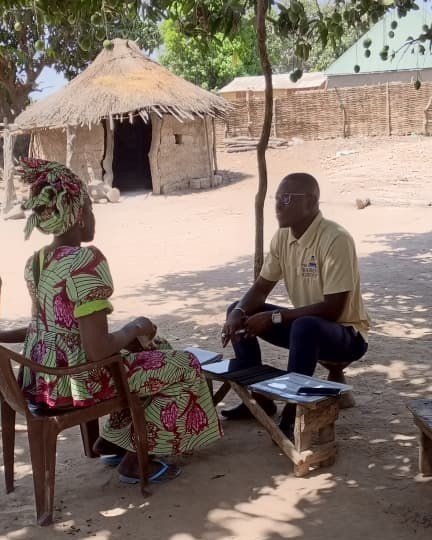
The study will be anchored in areas where PRAPS-1 and PRAPS-2 investments have already been made. These may include water points, vaccination parks, livestock markets, veterinary services, pastoral infrastructure, and associated local governance arrangements.
The Kairos Group’s approach is based on a simple principle: infrastructure cannot be separated from the social and governance systems around it. A water point, livestock corridor, vaccination park, or market can only reduce tensions if the rules governing access are understood, accepted, applied, and seen as legitimate by different users — including resident herders, transhumant pastoralists, farmers, women, youth, traders, local authorities, and non-beneficiaries.
KATS is The Kairos Group’s human-domain sensing and sensemaking platform. It is designed to transform qualitative field testimony into structured, comparable observations while preserving the richness of local voices.
For this PRAPS-2 study, KATS will help connect:
The goal is not to replace the formal PRAPS-2 indicator. The goal is to strengthen it. The quantitative indicator will provide a measurable result. The KATS qualitative layer will explain the mechanisms behind that result and help identify where future attention may be needed.
This work also opens the door to a broader ambition: using structured field data to detect early signals of tension before they appear in formal reporting systems. When people speak about conflict, they often also speak about what worries them — corridors closing, water points becoming contested, rules not being respected, committees no longer functioning, or groups losing trust in local arrangements.
Just as importantly, communities often identify what could help prevent deterioration. That means the same testimony that points to risk can also point to practical early action.
This is where KATS brings particular value: connecting testimony, territory, investment sites, governance arrangements, and decision-making. The goal is to support a more conflict-sensitive, locally grounded, and actionable approach to monitoring and evaluation in pastoral systems.
The Kairos Group is honored to collaborate with CILSS, STATINFO, the World Bank, and the national PRAPS-2 teams on this important mission. We look forward to contributing to work that supports pastoralism, resilience, local governance, and conflict prevention across the Sahel.
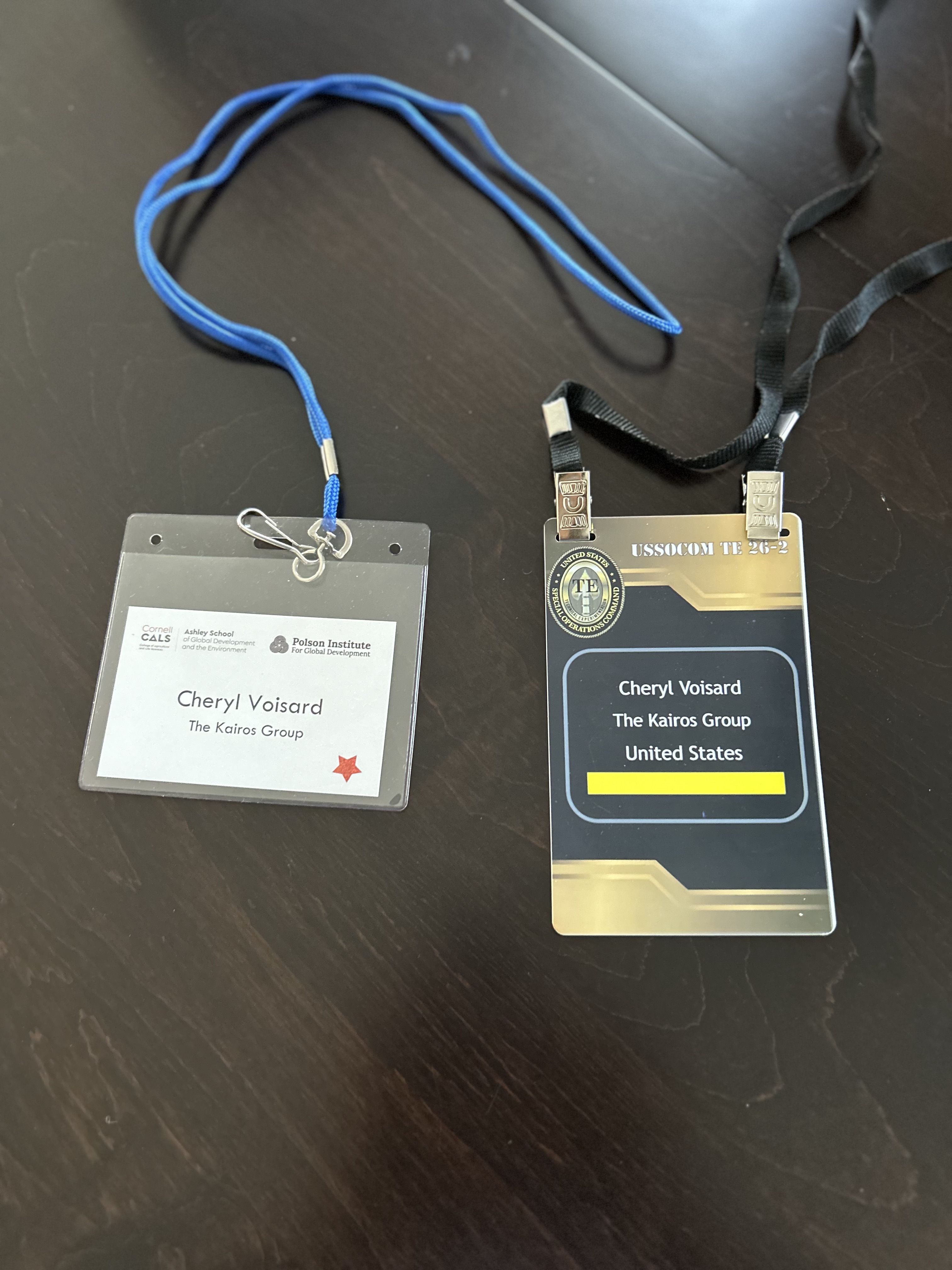
April was an important month for Kairos, one that brought together two very different communities, united by a common question: How do we better understand human behavior in complex, rapidly changing environments?
I had the privilege of returning to Cornell as a keynote speaker for the Polson Institute for Global Development’s 25th Anniversary Symposium. As an alumna, it was genuinely meaningful to be back among familiar faces and longtime colleagues. I shared our Senegal pilot with a room of researchers and practitioners thinking seriously about the future of international development and where AI fits into it.
Just days later, I was presenting the KATS platform at USSOCOM’s Technology Experimentation event (TE 26-2), engaging with companies working at the leading edge of agentic AI, autonomy, and defense innovation. Different pace, different language, different priorities, and yet the same underlying question: How do we turn complexity into actionable insight when traditional data isn’t enough?
The KATS platform drew strong interest across both settings because it sits at the intersection of both worlds. Whether we’re looking at agricultural systems in Senegal or contested environments modeled at USSOCOM, the core problem is the same: understanding how people adapt and make decisions under uncertainty.
What struck me most is how much the two communities share, even when they don’t know it. Both are trying to make sense of human behavior in systems under stress. Both are frustrated by data that arrives too late or at the wrong level of abstraction. The technologies differ, but the frustration with conventional approaches is something both communities know well.
I left both conversations more convinced that the work matters, and more curious about where it goes next.
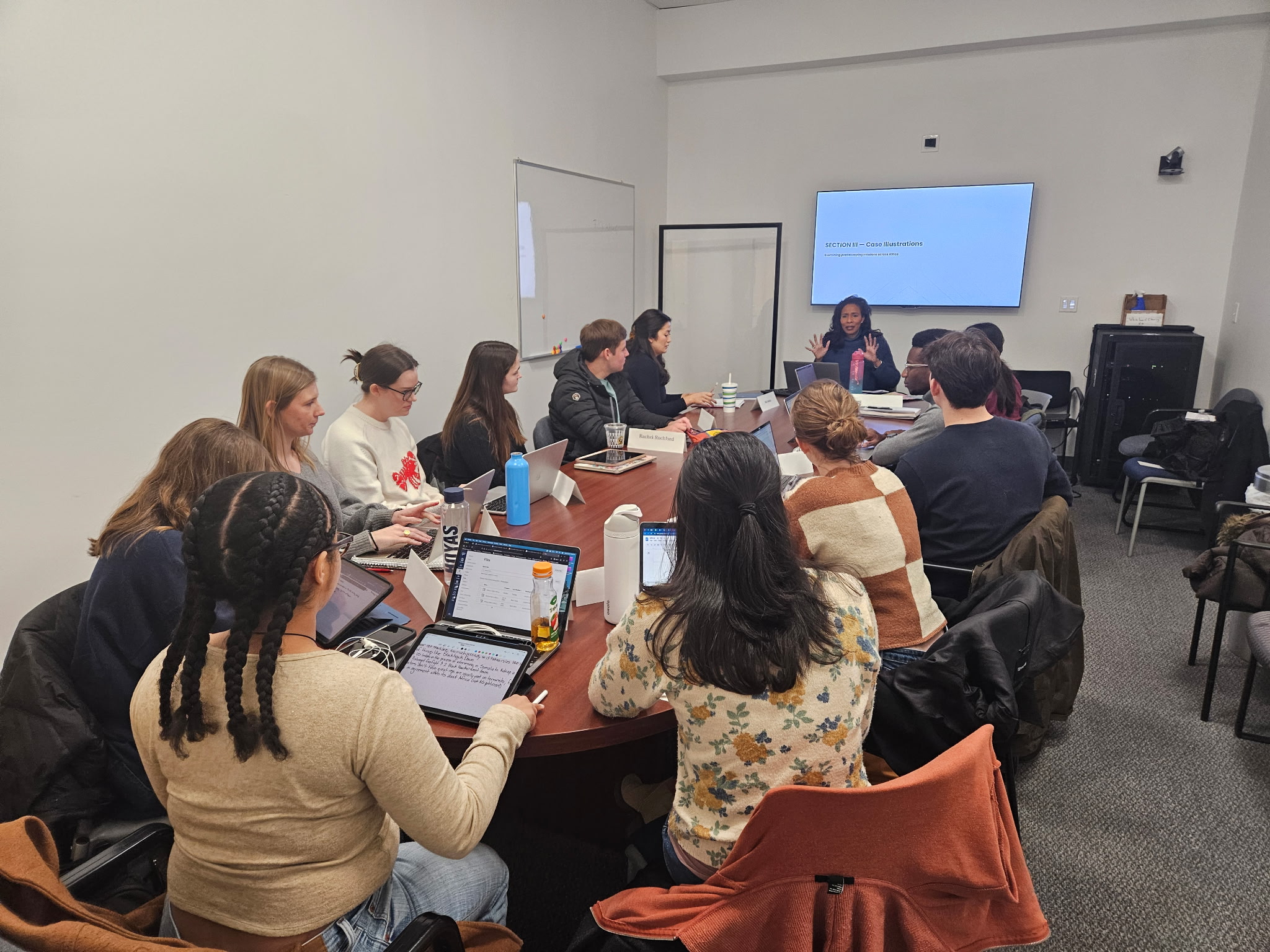
This week, I had the privilege of returning to Georgetown University to teach a seminar on Peacekeeping and Stabilization Operations for the course The Military’s Role in Africa.
Coming back to Georgetown to teach, rather than learn, felt unexpectedly meaningful. As a graduate of the School of Foreign Service (SFS), I reflected on how this institution fundamentally shaped my ideas about power, legitimacy, and the messy relationship between security and development. SFS instilled something I still carry—the conviction that policy only works when it understands political reality.
That is exactly what we delved into.
The core theme was straightforward: peacekeeping is not warfighting. Stabilization is not peace. Security is necessary, but insufficient.
We walked through case studies from Somalia, Mali, the DRC, and Liberia, examining why some missions struggle and others succeed. One pattern that kept emerging: although security can create space, it is politics that determines whether that space is filled with legitimacy or collapses back into violence.
Students wrestled with hard questions. Why does enforcement become the default? What happens when we skip stabilization? Why do we keep asking military tools to solve governance problems?
These questions were not merely academic debates. They surfaced structural vulnerabilities in U.S. national security policy—and these vulnerabilities sit at the core of what we are addressing at The Kairos Group.
After years of working in this space, I have found that one of the hardest challenges in stabilization is not logistics or funding. It is understanding what is actually happening on the ground.
Historically, Civil Affairs teams, UN missions, and development actors rely on narrative reports, lagging indicators, or gut instinct. Data moves slowly. Sentiment shifts quickly. Commanders decide based on incomplete human-domain insight.
This gap between lived reality and decision-making is precisely where KATS (The Kairos Agentic Trust & Sensemaking Platform) operates.
At The Kairos Group, we are working at the forefront of an emerging field: Human-Domain Sensing.
Sensing is not surveillance, intelligence targeting, or social media scraping. It is fundamentally different. It is about capturing structured field observations, interpreting qualitative impressions responsibly, detecting shifts in trust and legitimacy over time, and providing explainable, human-validated assessments decision-makers can actually use.
In fragile and austere environments, perception is reality. If trust collapses, access disappears. If legitimacy erodes, stabilization fails. If humanitarian neutrality is questioned, lives are at risk.
Sensing translates everyday engagements—a key leader conversation, a school visit, a market walkthrough—into structured insight that supports decision-making without replacing human judgment.
In the classroom, we talked about how militaries create space for political dialogue. In practice, sensing helps us understand what fills that space. It introduces feedback. It helps answer: Is the community benefiting from our work? Are outliers emerging? Is resentment building? Are our actions strengthening or undermining legitimacy?
For decades, we have invested billions in sensing the physical domain—technologies like ISR, geospatial intelligence, and signals collection. But conflict is increasingly political, informational, and perception-driven.
We are entering the era of sensing the human domain responsibly. That requires ethical guardrails, bias awareness, traceability, governance controls, and human authority over every output. It is an emerging discipline at the intersection of international security, development, AI, and civil-military coordination. We are proud to be building at that edge.
In that Georgetown classroom, I recognized something hopeful. The next generation grasps the complexity we often overlook. They understand security alone is insufficient. They instinctively were asking about legitimacy, sequencing, and unintended consequences.
The future does not hinge on new doctrinal language. It hinges on better instruments of perception—sensing mechanisms that illuminate the environments leaders are actively reshaping. In peacekeeping and stabilization operations, security may create space. Trust is what sustains it. And if we fail to sense when that trust begins to erode, we are already too late.
Field reflections, platform updates, and dispatches from our engagements. Reach out if you’d like to be added to the list.
Kairos—the ancient Greek word for the right, critical, or opportune moment—names what decision-makers are trying to find: the point at which acting changes the trajectory. We build the tools and practice that let leaders see that moment coming.
The firm was founded by Dr. Cheryl Voisard, a senior advisor with more than two decades at the intersection of international development, diplomacy, and defense. The career arc is unusual on purpose: it spans USAID Foreign Service, advisory work at SOCAFRICA, stabilization engagements in Iraq, and leadership on Power Africa—because the human-domain problems at the heart of each of those assignments turned out to rhyme.
That cross-sector experience is the DNA of our methodology. We treat field reality as the primary source—not a footnote to a desk-based model—and we build the instrumentation that turns that reality into a continuous signal decision-makers can act on.
Kairos was founded to bridge the gap between field reality and strategic decision-making. Everything we ship—the KATS platform, the 2–1–1™ framework, the Trust Index, the Community Engagement Index—is built toward that one purpose.
Scoping a new engagement, stress-testing a strategy in motion, or exploring whether the KATS platform fits your operating picture? We’d like to hear from you. Most engagements begin with a confidential 30‑minute conversation.